Research
Reading the Surface: What Condition Reports Reveal
A condition report is more than a checklist. For the trained eye, it is a narrative — of use, neglect, repair and survival.

Before any significant work of art changes hands — before it is sold, loaned, insured or conserved — it is examined. The record of that examination is the condition report: a systematic account of the object's physical state, its history of damage and repair, and the risks it carries. For most buyers and sellers, the condition report is a formality, a document to be filed and forgotten. For the conservator, it is something else entirely.
A condition report, read carefully, is a biography of an object's physical life. It records not only what the object looks like now, but what has happened to it — the accidents, the neglect, the interventions, the survivals. It is, in this sense, a form of history: partial, technical, often dry in its language, but rich in what it implies.
What a Condition Report Is
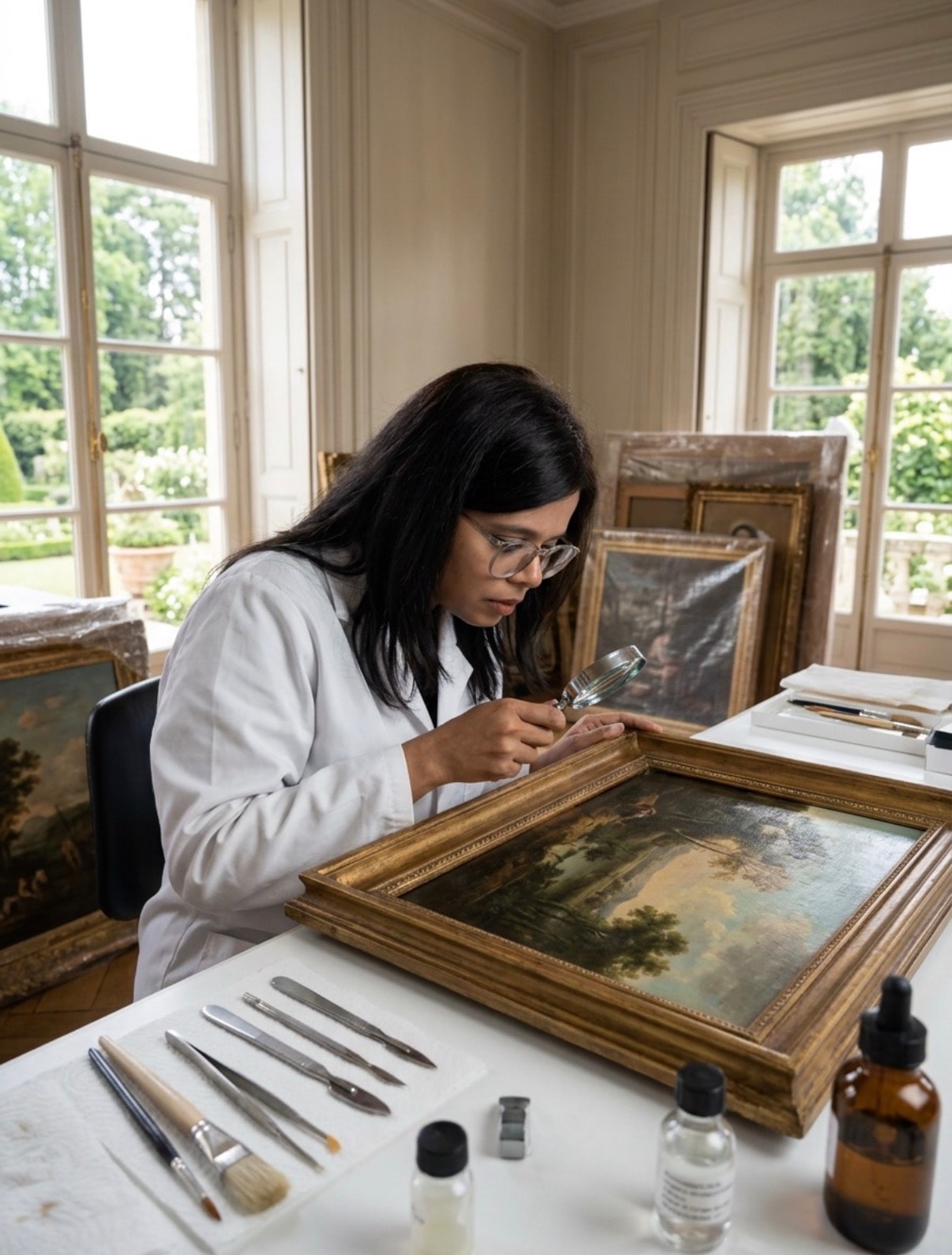
A standard condition report for a painting will cover the support (canvas, panel, paper), the ground layer, the paint layer, the varnish, and any previous restorations. It will note areas of loss, cracking, flaking, discolouration, abrasion and overpainting. It will describe the condition of the frame, if present. It will be accompanied by photographs — overall views, details, and often images taken under raking light, ultraviolet and infrared, each of which reveals different aspects of the object's condition.
The language of condition reports is precise and, to the uninitiated, opaque. Terms like "tenting," "cleavage," "blanching," "pentimento" and "retouching" carry specific technical meanings. Learning this vocabulary is part of learning to read the report — and learning to read the report is part of learning to understand what you own, or what you are considering owning.
"A condition report, read carefully, is a biography of an object's physical life — partial, technical, but rich in what it implies."
The Language of Damage
Every form of damage tells a story. Craquelure — the network of fine cracks that develops in aged paint — is, in most cases, a sign of age rather than deterioration; its pattern can even help date a work or identify its origin. Tenting, where the paint layer lifts from the ground in small peaks, suggests a history of fluctuating humidity — perhaps a work that has been stored in an uncontrolled environment, or moved frequently between climates.
Abrasion — the thinning of the paint layer through overcleaning — is one of the most common and most damaging forms of deterioration in old paintings. It is often the result of well-intentioned but misguided cleaning in the past, when solvents were applied too aggressively or too frequently. An abraded painting has lost something irreplaceable: the subtlety of the artist's touch, the glazes and scumbles that gave the surface its depth. The condition report will note abrasion, but it cannot convey the full extent of what has been lost.
What the Report Cannot Say
A condition report describes what is observable. It cannot always explain why damage has occurred, or what it means for the long-term stability of the object. A painting with extensive cracking may be perfectly stable; a painting that appears sound may be on the verge of significant loss. The report is a snapshot, not a prognosis — and reading it as a prognosis requires experience and judgement that no document can fully substitute for.
This is why, for any significant acquisition, we recommend that collectors commission an independent condition examination rather than relying solely on the report provided by the seller. The seller's report is not necessarily dishonest — most are prepared by reputable conservators and are accurate as far as they go. But an independent examination may reveal things that the seller's report did not look for, or did not choose to emphasise.
Raking Light and Revelation
Among the most revealing tools in condition examination is raking light — a strong directional light source held at a low angle to the surface of the work. Under raking light, the topography of the paint surface becomes visible: the impasto, the brushwork, the areas where the paint has been built up or worn away. Old restorations, which may be invisible under normal lighting, often become apparent as areas of slightly different texture.
Ultraviolet light reveals varnish layers and restorations: old varnish fluoresces a characteristic greenish-yellow, while more recent additions appear dark. A painting examined under UV that shows large dark areas — areas that do not fluoresce — has been extensively restored in those regions. This is not necessarily a problem, but it is information that a buyer should have.
Old Restorations
The presence of old restorations is one of the most nuanced aspects of condition assessment. A well-executed restoration, carried out by a skilled conservator using appropriate materials, may have stabilised the work and extended its life significantly. A poorly executed restoration — using inappropriate materials, applied too thickly, or covering areas of original paint — may have done more harm than good.
The condition report will note the presence of restorations and, ideally, assess their quality and stability. But the full picture often requires examination of the restoration materials themselves — which may have discoloured, become brittle, or begun to detach. An old restoration that was once invisible may now be highly visible; one that appeared stable may be failing. These are things that only direct examination can reveal.
Reading Between the Lines
The most important skill in reading a condition report is knowing what questions to ask. A report that describes a work as being in "good condition overall" may be accurate — or it may be eliding significant problems. A report that lists extensive damage may be more honest, and the damage itself may be less serious than it sounds. The language of condition reports rewards careful reading and, where necessary, follow-up questions.
At I'Arte Rinasce, we prepare condition reports for every work that passes through our hands, and we make them available in full to prospective buyers. We believe that transparency about condition is not a commercial liability — it is a mark of integrity. A collector who understands what they are buying, and what it requires, is a better custodian than one who has been kept in the dark. The surface of a work of art has a great deal to say, if you know how to listen.
Editorial Team I'Arte Rinasce