Conservation
Kintsugi and the Philosophy of Repair
The Japanese art of repairing broken pottery with gold offers a profound lens through which to view conservation — damage as biography, not failure.

There is a bowl in the collection of the Tokyo National Museum that was broken, repaired, and broken again. Each time it was mended with urushi lacquer mixed with gold powder, so that the lines of fracture became lines of gold running across the surface like rivers seen from above. The bowl is more beautiful for having been broken. It is also, in a very precise sense, more itself.
This is kintsugi — the Japanese art of repairing broken ceramics with gold. The word means, roughly, golden joinery. The practice is associated with the aesthetic philosophy of wabi-sabi, which finds beauty in imperfection, transience and incompleteness. But kintsugi is more than an aesthetic preference. It is a philosophy of repair — a set of propositions about what damage means, and what we owe to broken things.
The Gold Seam
The central proposition of kintsugi is that breakage is part of the history of an object, not a deviation from it. To conceal a repair — to make the mended bowl look as though it had never been broken — would be to falsify that history, to pretend that something had not happened. The gold seam is a refusal of that pretence. It says: this happened. It is part of what this object is.
This is a radical position in the context of conservation, where the dominant tradition has long been one of invisibility. The ideal repair, in Western conservation practice, is one that cannot be seen — that restores the object to an appearance of wholeness. The kintsugi approach inverts this: the repair should be visible, even celebrated. The wound becomes an ornament.
"The gold seam is a refusal of pretence. It says: this happened. It is part of what this object is."
Damage as Biography
The kintsugi philosophy rests on a particular understanding of what objects are. They are not static things — fixed at the moment of their making and thereafter simply preserved or degraded. They are dynamic entities, accumulating history through use, damage, repair and survival. Each mark, each crack, each mend is a record of something that happened. To erase those records is to impoverish the object.
This is not a counsel of neglect. Kintsugi does not celebrate damage for its own sake — it celebrates the survival of damaged things, and the care that makes survival possible. The gold is not applied to a broken bowl that has been left to deteriorate; it is applied to a bowl that has been carefully mended, its fragments reassembled with skill and attention. The beauty of kintsugi is inseparable from the labour it represents.
What Western Conservation Assumes
Western conservation ethics, as codified in the twentieth century, rests on several principles that are in tension with the kintsugi approach. The principle of reversibility holds that any intervention should be undoable — that future conservators should be able to remove what we have done. The principle of minimal intervention holds that we should do as little as possible. The principle of distinguishability holds that repairs should be detectable on close examination, even if not immediately visible.
These principles are not arbitrary. They reflect a hard-won understanding of the limits of our knowledge and the fallibility of our judgements. What seems like the right intervention today may seem wrong in fifty years. Reversibility preserves options; minimal intervention limits damage; distinguishability maintains honesty. They are good principles, and we follow them.
A Different Question
But kintsugi asks a different question. It does not ask: how do we preserve the object as it was? It asks: how do we honour the object as it is — including everything that has happened to it? This is not a question that Western conservation has always been comfortable with. The impulse to restore, to return an object to an earlier state, can shade into a kind of denial — a refusal to acknowledge that time has passed and things have changed.
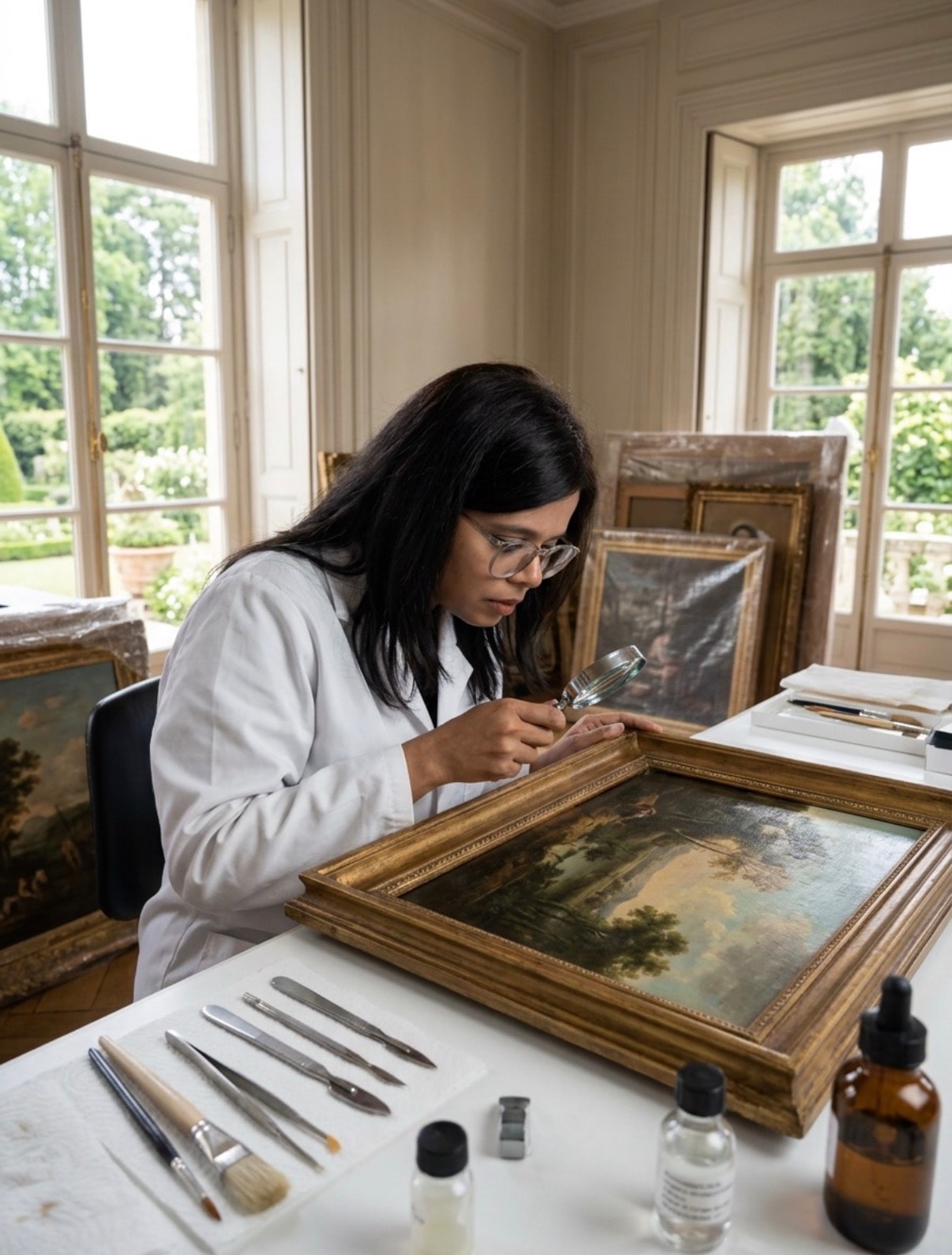
The best conservation practice already incorporates something of the kintsugi sensibility. A good conservator does not try to make an old painting look new; they try to stabilise it, to slow its deterioration, to make its history legible. They document what they find and what they do. They treat the object as a record, not just as an aesthetic object.
The Limits of the Analogy
Kintsugi has become, in recent years, something of a cultural shorthand — a metaphor for resilience, for finding beauty in brokenness, for the value of imperfection. This is not wrong, but it risks flattening the specificity of the practice. Kintsugi is not a general philosophy of optimism. It is a precise technical and aesthetic tradition, rooted in particular cultural values, applied to particular kinds of objects in particular ways.
To apply its logic wholesale to Western conservation would be a mistake — and not only because the materials and techniques are different. The cultural contexts are different too. What kintsugi means in the context of Japanese ceramic tradition is not the same as what visible repair would mean in the context of a Flemish oil painting. Context is everything in conservation, as in art.
What Kintsugi Teaches
What kintsugi offers to the conservator is not a technique but a question: what is the relationship between damage and identity? When we repair an object, what are we trying to preserve — its appearance, its function, its history, its meaning? These are not the same thing, and the answer will be different for different objects in different contexts.
The gold bowl in Tokyo is not trying to look unbroken. It is trying to be fully what it is — a vessel that has lived, been damaged, been cared for, and survived. That is a different ambition from most conservation, and a more honest one. We do not need to adopt it wholesale to learn from it. The question it poses — what do we owe to broken things? — is one that every conservator should carry with them into the studio.
Editorial Team I'Arte Rinasce