Conservation
The Importance of Art Conservation in the Digital Age
As cultural institutions move online, the physical act of conservation takes on new meaning. We explore how traditional methods intersect with contemporary preservation challenges.

There is a particular irony in writing about art conservation for a digital publication. The essay you are reading exists as light on a screen — weightless, reproducible, infinitely copyable. The objects we conserve are none of these things. They are singular, material, mortal. And yet here we are, navigating a world in which the digital and the physical are increasingly entangled, and in which the question of what we preserve — and how — has never been more urgent.
The past decade has seen an extraordinary acceleration in the digitisation of cultural heritage. Museums, libraries and archives have invested heavily in high-resolution scanning, 3D modelling and online access programmes. The Google Arts & Culture platform now hosts virtual tours of hundreds of institutions. The Rijksmuseum makes its entire collection available for free download. These are genuine achievements — they have democratised access to objects that were previously available only to those with the means and mobility to travel.
The Paradox of Digitisation
But digitisation carries within it a dangerous assumption: that the copy is sufficient. That once an object has been photographed, scanned and uploaded, its survival becomes less pressing. This assumption is wrong, and it is worth examining why.
A digital image of a painting is not the painting. It captures colour (imperfectly, given the variability of screens and calibration), it captures composition, it captures something of surface. But it cannot capture the physical presence of the object — the weight of the panel, the texture of the impasto, the way light moves across a varnished surface at different angles. It cannot capture the smell of old wood, or the particular quality of silence that surrounds a very old thing. These are not trivial losses. They are, in many cases, the very substance of the aesthetic experience.
"A digital image of a painting is not the painting. The copy is never sufficient — it is a reminder of what we stand to lose."
What the Screen Cannot Carry
Consider the conservation of a fifteenth-century panel painting. The conservator's first task is examination — not of a reproduction, but of the object itself, under raking light, ultraviolet, infrared reflectography. Each of these techniques reveals something invisible to the naked eye: underdrawing, earlier compositions, areas of loss, old restorations. The painting is, in this sense, a palimpsest — a layered document of its own history.
None of this is accessible through a digital image, however high its resolution. The digital record is a record of appearance, not of substance. It tells us what the painting looks like; it cannot tell us what it is made of, how it was made, or what has happened to it over five centuries. For the conservator, the object itself remains irreplaceable — not as a sentimental preference, but as a practical necessity.
Technology as Tool, Not Replacement
This is not an argument against technology. On the contrary: the tools available to conservators today are extraordinary. X-ray fluorescence mapping can identify pigments non-invasively. Multispectral imaging can reveal inscriptions invisible to the naked eye. 3D scanning can document surface topography with sub-millimetre precision. These technologies have transformed conservation practice, and we use them gratefully.
The distinction we must maintain is between technology as a tool for understanding and caring for objects, and digitisation as a substitute for their physical preservation. The former is invaluable. The latter is a category error — a confusion of the map for the territory.
The Conservator's Responsibility
In this context, the conservator's role becomes, if anything, more important in the digital age — not less. As the assumption grows that objects can be adequately preserved through their digital surrogates, the case for physical conservation must be made more clearly and more urgently. We must articulate, to collectors, institutions and the public, what is at stake when an object deteriorates beyond recovery.
We must also be honest about the limits of our own practice. Conservation is not preservation in perpetuity — it is the management of inevitable change. Every material ages; every intervention carries risk. What we can offer is not immortality but time: the extension of an object's useful life, the slowing of its decay, the maintenance of its capacity to be experienced and studied by future generations. That is a modest but essential ambition.
Looking Forward
The digital age has given us new audiences for cultural heritage, new tools for its study, and new platforms for its dissemination. These are genuine gifts. But they do not change the fundamental nature of the conservator's work, which is physical, material and irreversibly bound to the objects themselves.
The challenge for our profession — and for the institutions and collectors who support it — is to hold both realities in mind simultaneously: to embrace the possibilities of the digital without losing sight of the irreplaceable value of the physical. To remember that the screen is a window, not a room. And that the room — the studio, the gallery, the store — is where the real work happens.
I'Arte Rinasce was founded on the conviction that objects carry memory, and that memory is worth protecting. In a world increasingly mediated by screens, that conviction feels more necessary than ever.
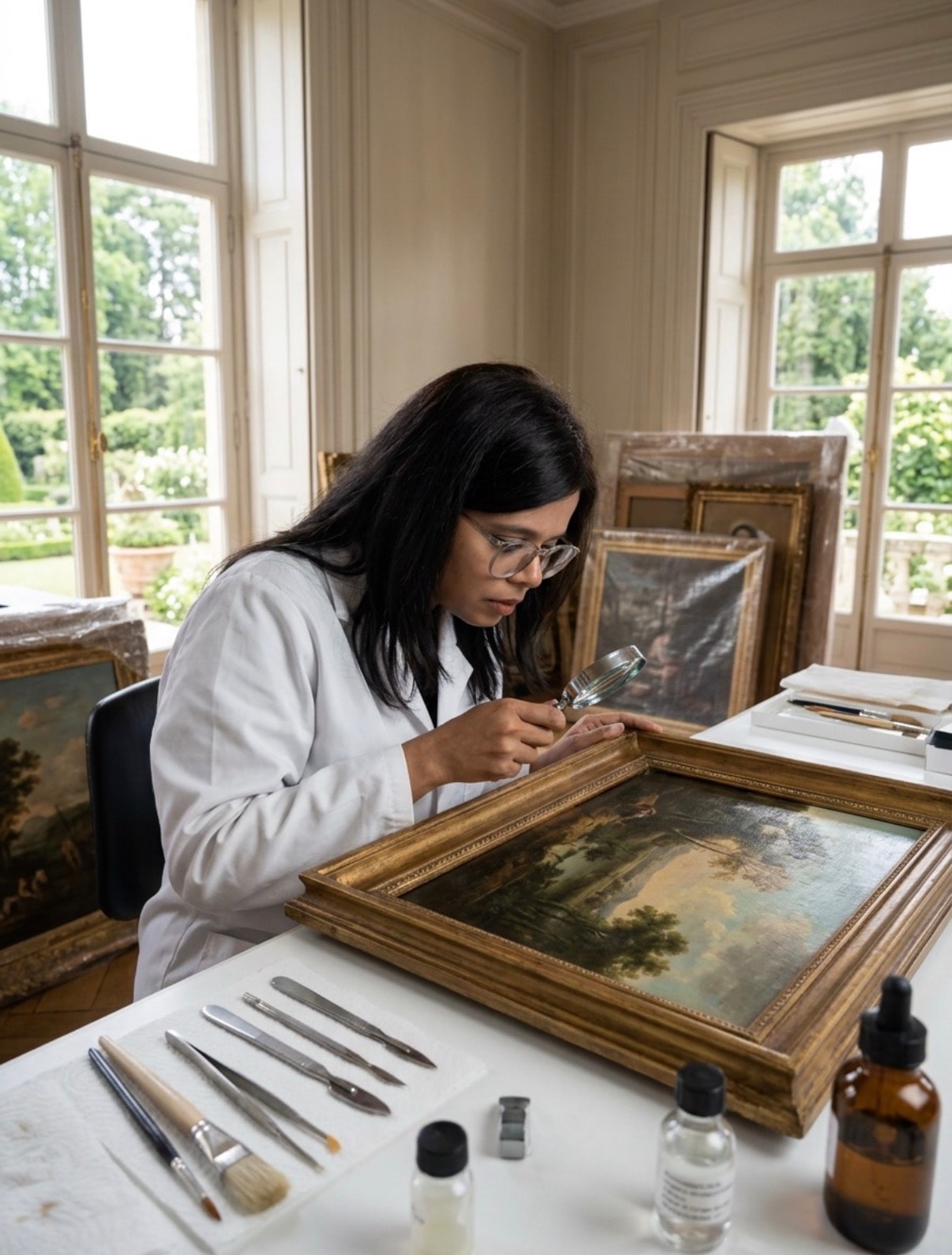
Aishwarya Ch
Founder & CEO, I'Arte Rinasce