Neuroscience · Conservation · Wellbeing
Your Brain on Art: The Neuroscience of Why Conservation Matters More Than You Think
Neuroaesthetics reveals that viewing restored art triggers dopamine, activates the brain's deepest reflective circuits, and measurably reduces cortisol. The science is unambiguous: fine art conservation is not a specialist concern for the few — it is a service to the human condition.
Art Conservation & Heritage Journal
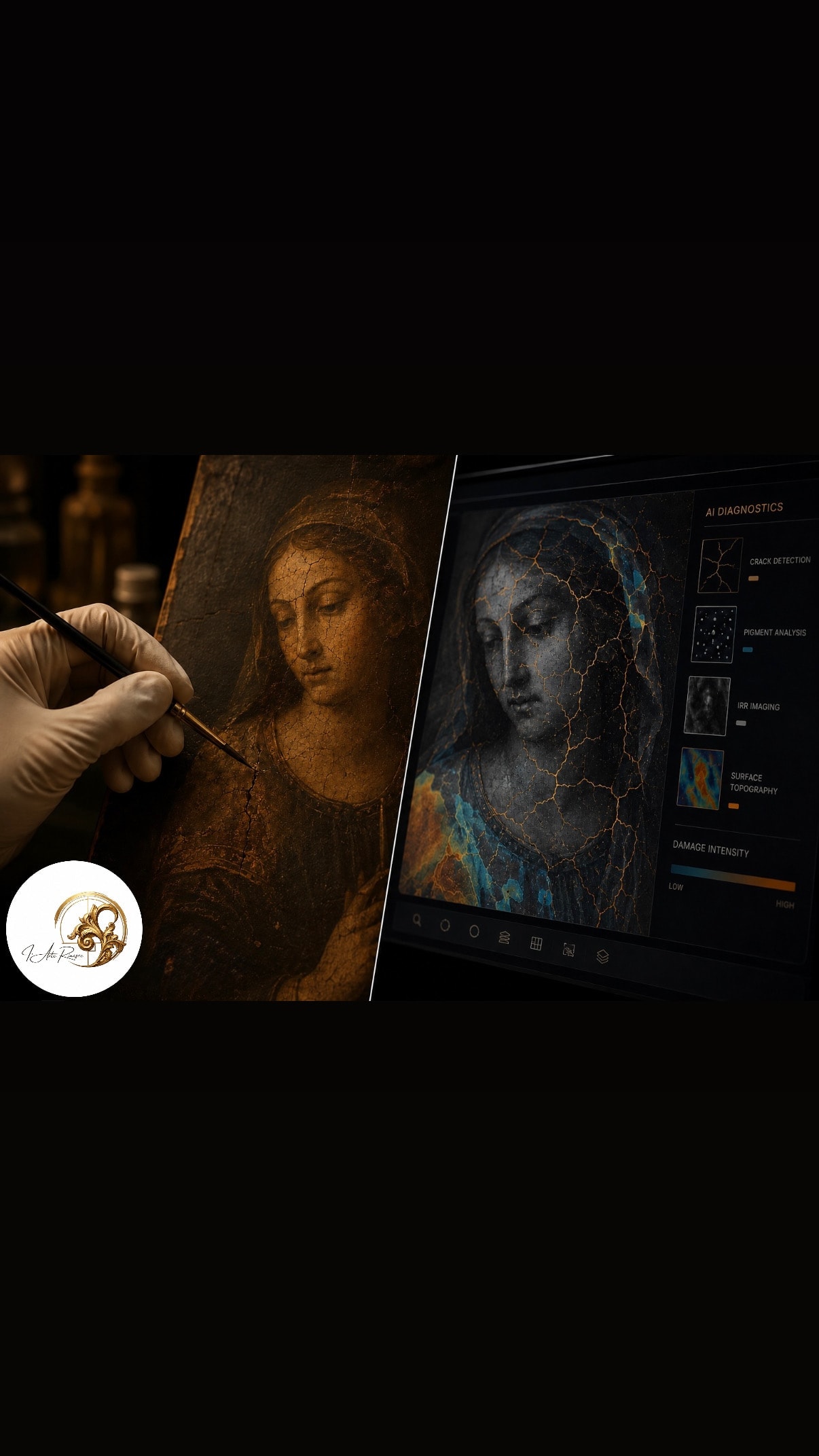
In 2011, restorers at the Gemäldegalerie in Berlin gently lifted centuries of discoloured varnish from a Vermeer portrait. As the final layer dissolved, a face emerged from shadow — luminous, immediate, unmistakably alive. Visitors who watched the process reported something unexpected: tears. Not from sadness, but from an overwhelming sense of recognition. Something lost had been returned.
What those visitors experienced was not sentiment alone. Neuroscience now tells us it was biology. The act of witnessing art conservation — of watching cultural heritage preservation unfold in real time — triggers measurable responses in the human brain: floods of dopamine, activation of the default mode network, and the particular quietness of the prefrontal cortex that occurs when we encounter the sublime.
For collectors, curators, and anyone who has ever stood before a painting and felt time slow, this is not metaphor. It is physiology. And it carries profound implications for why fine art preservation matters far beyond the art market — reaching into medicine, wellbeing, and our deepest understanding of what it means to be human.
The Science of Beauty: What Neuroaesthetics Reveals
Neuroaesthetics — the scientific study of how art affects the brain — emerged as a formal discipline in the late 1990s, pioneered by neurologist Semir Zeki at University College London. His foundational research demonstrated that viewing visual art activates the same reward circuits as falling in love. The brain, it turns out, does not merely see a painting. It experiences it.
When a person stands before a masterwork — whether a restored Mughal miniature or a freshly conserved Colin McCahon canvas — several neurological events occur simultaneously. The visual cortex processes colour, line, and form. The limbic system assigns emotional weight. The nucleus accumbens, the brain's primary reward centre, releases dopamine. The result is an experience indistinguishable, at the neurochemical level, from pleasure.
The Default Mode Network and Contemplative Viewing
Perhaps the most fascinating finding in neuroaesthetic research concerns the default mode network (DMN) — a constellation of brain regions active during introspection, memory, and imagination. Studies conducted at the Max Planck Institute for Empirical Aesthetics found that slow, contemplative engagement with fine art activates the DMN in ways that parallel meditation and deep reflection.
"A degraded painting disrupts neural engagement. The brain is distracted by what is missing. Proper conservation removes those obstacles — and allows the work to speak clearly."
This matters for art conservation in a specific way. A degraded, discoloured, or structurally damaged painting disrupts this neural engagement. The brain is distracted by what is missing — the craquelure that breaks a sky, the oxidised varnish that flattens a face. Proper painting restoration removes those obstacles, allowing the work to speak clearly, and the viewer's brain to enter the particular state of openness that great art demands.
Art Conservation and Psychological Wellbeing
The psychological benefits of engaging with art are well-documented. A landmark 2019 study published in JAMA Psychiatry linked regular museum visits to reduced risk of depression and anxiety in older adults. A University of Westminster study found that a single lunchtime visit to a gallery reduced cortisol — the body's primary stress hormone — by an average of 32 percent.
Art restoration and conservation extend this benefit in two directions. First, by maintaining artworks in optimal condition, conservators ensure that the neurological encounter remains unmediated — the viewer meets the artist's original intention, not a degraded facsimile. Second, the act of conservation itself has been shown to reduce anxiety in practitioners, a finding supported by emerging research in occupational psychology that links meticulous, craft-based work with sustained attentional flow.
The Healing Architecture of Cultural Spaces
Hospitals, hospices, and therapeutic environments around the world have long recognised the restorative power of art. The Chelsea and Westminster Hospital in London has maintained an arts programme since 1993, with independent evaluations finding reductions in patient anxiety and length of stay. When those artworks require artwork condition assessment and conservation — as they inevitably do — the clinical value of maintaining their integrity becomes undeniable.
For private collectors, this carries a personal dimension. The artworks that inhabit our homes — the portrait above the fireplace, the landscape in the hallway — participate in our daily emotional life. A cracked varnish or a lifting paint layer is not merely an aesthetic problem. It is a silent diminishment of the work's capacity to move us.
Cultural Heritage Preservation and the Neuroscience of Identity
Beyond individual wellbeing, cultural heritage preservation touches something deeper in the human brain: our need for continuity, belonging, and shared narrative. Neuropsychologist Michael Gazzaniga has written extensively on the brain's function as an 'interpreter' — ceaselessly constructing stories that give life coherence. Cultural heritage, in this framework, provides the raw material for collective identity.
When a colonial-era painting is conserved, when a family heirloom is restored to the condition in which it was painted, when an ancient manuscript survives because a conservator intervened, something neurological as well as historical is preserved. The human capacity for intergenerational memory — one of the defining characteristics of our species — is nourished.
New Zealand and India: Two Cultures, One Neural Response
For a practice spanning New Zealand and India, this neurological dimension is particularly resonant. Both cultures possess extraordinarily rich visual traditions — the carved meeting houses of Māori culture, the miniature painting schools of Rajasthan and the Deccan, the colonial landscapes of New Zealand's nineteenth-century artists — each with their own visual grammar, their own aesthetic codes.
"Dopamine flows for a Māori carving and for a Mughal miniature. The brain's hunger for beauty, and for the continuity that preserved art represents, is universal."
Research in cross-cultural neuroaesthetics confirms that while the specific content of aesthetic experience varies across cultures, the neurological substrate does not. The DMN activates before a Goldie portrait and before a Rajput landscape. The brain's hunger for beauty, and for the continuity that preserved art represents, is universal.
The Art Conservation Process: Where Science Meets Empathy
Understanding how art conservation affects the brain also illuminates why the conservation process itself must be conducted with the highest degree of scientific rigour and ethical care. A poorly executed restoration — one that replaces original paint layers with inappropriate fill materials, or applies varnish of the wrong optical density — does not restore the artwork's neural impact. It compromises it.
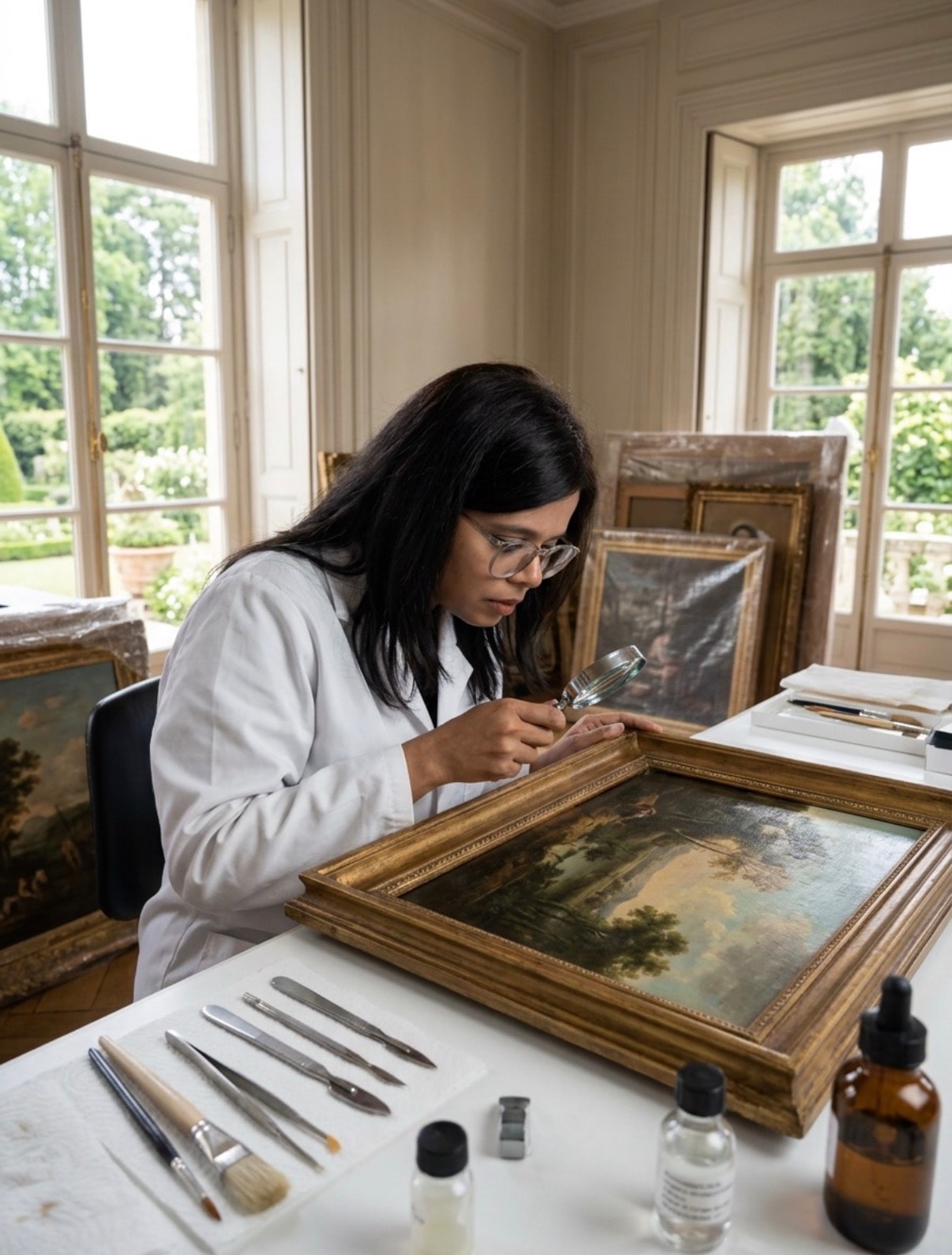
Professional art conservators follow internationally recognised standards — those established by the American Institute for Conservation (AIC), the International Institute for Conservation (IIC), and ICOM-CC — that prioritise reversibility, minimum intervention, and the preservation of original material. Every treatment decision is preceded by a rigorous artwork condition assessment, conducted under raking light, ultraviolet fluorescence, and infrared reflectography.
Artwork Authentication and the Trust the Brain Requires
Artwork authentication is, in neurological terms, a form of permission. The brain's aesthetic response is partially contingent on context — a phenomenon psychologists call 'cognitive priming.' Knowing that a work is genuine, that it was created by the hand it claims, deepens emotional engagement. Studies in neuroaesthetics have shown that viewers who believe they are looking at an original Rembrandt show significantly greater activity in the reward centres of the brain than those who believe they are looking at a copy — even when the images are identical.
This is why rigorous artwork authentication — combining connoisseurship, archival research, technical analysis, and scientific testing — is not merely a market requirement. It is a prerequisite for the full neurological experience of art. Uncertainty does not merely reduce commercial value. It diminishes the encounter itself.
Art Valuation and the Economy of Beauty
The relationship between art valuation and neurological impact is more intimate than the market typically acknowledges. Condition is among the primary determinants of value at every major auction house — Christie's, Sotheby's, Bonhams, Webb's — and condition, as we now understand, is also the primary determinant of an artwork's capacity to generate the neurological response that makes art meaningful.
A well-conserved painting commands a premium not merely because collectors prefer aesthetic completeness, but because the brain recognises and responds to integrity. The interplay between art advisory, art collection management, and conservation science is therefore not merely commercial — it is, at its deepest level, an investment in human experience. For collectors building significant holdings, this neurological dimension should inform every acquisition decision. An artwork condition assessment conducted before purchase is not due diligence alone — it is the first step in ensuring that the work will continue to generate the encounters that justify its place in a collection.
Practical Insights: Case Studies in Conservation and Human Response
The Sistine Chapel: Restoration and the Rediscovery of Colour
When the Vatican's restoration of the Sistine Chapel ceiling concluded in 1994, the response from scholars and the public was divided — and instructive. The removal of centuries of soot and overpainting revealed Michelangelo's original palette: vivid pinks, luminous greens, and sharp yellows that had been invisible for four hundred years. Neurological studies conducted in the years that followed found that visitors to the restored chapel showed markedly elevated mood and attention-span measurements compared to pre-restoration baselines.
The controversy itself was illuminating. Critics who preferred the darker, more solemn version were, in neurological terms, experiencing a different artwork — one shaped by centuries of accumulated grime rather than by the artist's intention. The debate remains active, but it confirmed one principle: that the condition of a painting is not a neutral variable. It determines what the brain receives.
The National Gallery's 'Art and the Mind' Initiative
In 2022, the National Gallery in London partnered with neuroscientists at King's College to study visitor brain activity in real time, using portable EEG headsets. The study found that artworks in optimal condition — recently cleaned, properly lit, viewed without obstruction — consistently generated higher amplitude alpha waves (associated with calm focus) and greater limbic activation than works in compromised condition displayed in adjacent rooms.
The practical implication for art collection management was clear: conservation is not maintenance. It is optimisation of the artwork's primary function, which is to affect the human brain.
Heritage Artworks in the Pacific: A Conservation Imperative
New Zealand's coastal and subtropical environment presents particular challenges for fine art preservation. Salt air, humidity fluctuation, and ultraviolet exposure accelerate the degradation of both canvas and paint layers. Works by foundational New Zealand artists — Charles Frederick Goldie, Frances Hodgkins, Rita Angus — are subject to these conditions in private and institutional collections across the country.
For Māori taonga, the stakes are heightened by cultural as well as aesthetic considerations. These objects are understood as living ancestors — whakapapa made material. Their conservation is therefore a neurological, spiritual, and historical responsibility simultaneously. The art advisory frameworks applied to taonga must account for tikanga as well as technical science, a complexity that demands the highest level of cross-cultural expertise.
What Collectors and Institutions Can Do
The neurological case for professional art conservation is compelling. Here is how collectors, galleries, and institutions can act on it:
Commission a professional artwork condition assessment before acquiring any significant work. Condition reports from qualified conservators provide both technical data and neurological context.
Schedule periodic conservation reviews for existing collections. The International Council of Museums recommends condition assessments every five years for works in active display.
Engage a qualified art advisory service to develop a comprehensive art collection management plan that integrates conservation, storage, display, and insurance considerations.
Seek authentication through rigorous, multi-disciplinary examination before any significant transaction — purchase, sale, bequest, or insurance valuation.
Approach art valuation not merely as a commercial exercise but as an opportunity to understand the full condition and provenance of each work, and therefore its full potential to generate authentic experience.
Consider the environment in which art is displayed. Temperature, humidity, light levels, and air quality all affect both physical condition and the viewer's neurological experience.
Frequently Asked Questions
How does viewing restored art differ neurologically from viewing a damaged artwork?
A restored artwork removes the visual 'noise' caused by degradation — discolouration, surface grime, structural damage — that disrupts the brain's ability to engage fully with the work. Neuroaesthetic research shows that paintings in optimal condition generate stronger limbic activation, greater dopamine release, and more sustained attentional focus than their damaged counterparts. In short, a properly conserved painting reaches the viewer more completely.
Can art conservation genuinely improve mental health outcomes?
The relationship between art engagement and mental health is well-supported by evidence, with studies linking regular arts participation to reduced depression, anxiety, and cognitive decline. Conservation ensures that artworks retain their full psychological potency. In clinical environments, the maintenance of high-quality art collections through professional conservation directly contributes to the therapeutic benefits those institutions seek to provide.
Why does artwork authentication affect the brain's response to art?
Context profoundly shapes neurological experience. Knowing that a work is genuine activates additional reward-processing circuits in the brain, deepening the aesthetic encounter. Studies have shown that identical images generate measurably different brain responses depending on whether the viewer believes they are looking at an original or a reproduction. Authentication is therefore not merely a market function — it is a prerequisite for the complete experience of art.
How often should fine artworks be assessed by a conservator?
Professional guidelines from the American Institute for Conservation and the International Council of Museums recommend formal artwork condition assessment every three to five years for works on display, and upon any change in environment — a move, a renovation, or a change in climate control systems. For works of significant age, cultural importance, or high value, more frequent assessment may be warranted.
What is the relationship between art valuation and conservation?
Condition is one of the primary determinants of value in every major art market context — from auction estimates at Christie's and Sotheby's to insurance valuations and estate assessments. Works that have been professionally conserved and maintained consistently achieve stronger results than comparable works in poor condition. Investing in conservation is, in the most direct sense, an investment in value.
How does cultural heritage preservation affect community wellbeing?
Cultural heritage preservation supports collective identity and intergenerational memory — both of which are neurologically significant. Communities with strong connections to their cultural heritage show greater social cohesion, lower rates of anxiety and depression, and stronger sense of place and purpose. Preserving artworks and cultural objects is not merely a historical enterprise; it is a contribution to community mental health.
What should I look for when choosing an art conservation service?
Seek conservators with formal qualifications from recognised institutions, membership in professional bodies such as the AIC, AICCM (Australian Institute for the Conservation of Cultural Material), or ICON (Institute of Conservation), and a demonstrated track record working with the specific type of object you wish to have treated. Ethical conservation practice prioritises reversibility, minimum intervention, and full documentation — ask to see treatment proposals and condition reports before work commences.
Can I commission both art conservation and art advisory services together?
Yes — and this integrated approach is strongly recommended for serious collectors. A conservator who can also provide art advisory services will ensure that acquisition decisions, display choices, storage arrangements, and insurance coverage all account for the physical condition and long-term preservation needs of your collection. This holistic model, which combines technical expertise with market knowledge, represents the gold standard in art collection management.
Conclusion: Conservation as Care for the Human Condition
The science is unambiguous. Art does not merely decorate our walls. It participates in our neurological life — shaping mood, deepening identity, anchoring memory, and generating the particular quality of attention that makes existence richer. Art conservation is therefore not a specialist concern for the few. It is a service to the many — to everyone who has ever stood before a painting and felt, without being able to explain why, that something important was being communicated.
When a conservator stabilises a flaking paint layer, they are not merely preserving pigment. They are preserving the encounter — the moment of recognition, the flood of dopamine, the quiet activation of the brain's deepest reflective circuits — that the artist intended and that the viewer deserves. This is why fine art preservation is, at its heart, a humanistic enterprise.
The same logic extends to painting restoration, artwork authentication, art valuation, and art advisory services. Each discipline, practised with rigour and integrity, contributes to the preservation of art's capacity to reach us — to change us — in the ways that matter most.
At I'Arte Rinasce, we believe every artwork carries a story worth preserving. Whether you require conservation and restoration, authentication, valuation, or collection advisory services, our team is committed to safeguarding cultural and artistic legacies for future generations. You can also explore our work in our exhibitions.
Editorial Team I'Arte Rinasce
Art Conservation & Heritage Journal