Conservation · Authentication · Legacy
The Machine That Learned to Heal Masterpieces — And Why the Human Hand Still Matters
AI is transforming art restoration — but can algorithms truly understand a painter's soul? I'Arte Rinasce explores the revolution reshaping how we preserve cultural heritage.
A Painting. A Machine. A Question That Changes Everything.
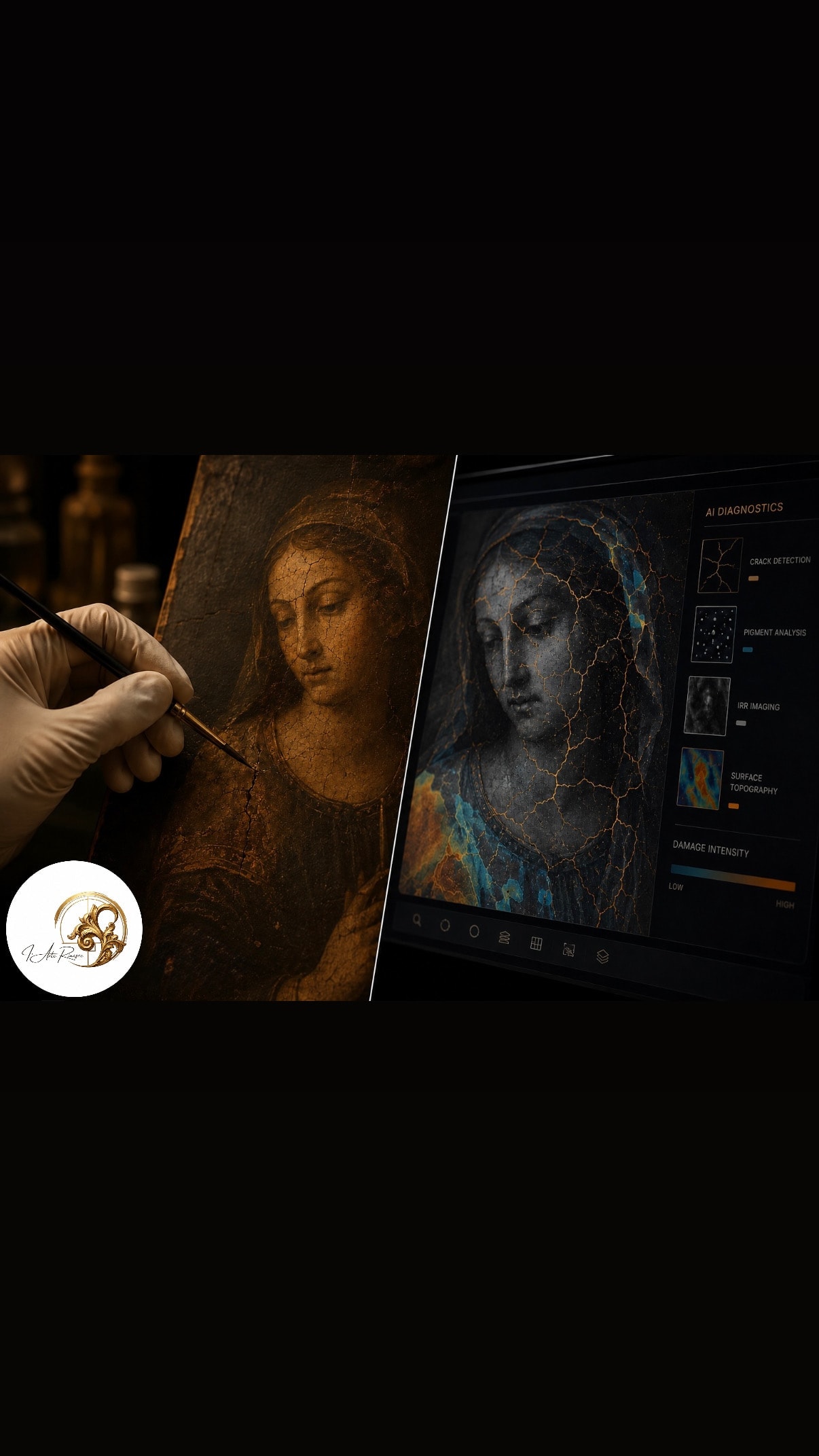
Imagine a 15th-century oil painting — its surface cracked, its colours faded to whispers, entire sections of the artist's vision swallowed by time. For centuries, its restoration would have demanded months of painstaking work by a skilled conservator, brush stroke by infinitesimal brush stroke.
Now imagine that same painting restored in three and a half hours.
This is no longer a thought experiment. In 2025, a mechanical engineering student at MIT named Alex Kachkine developed a technique that analyses a damaged painting using high-resolution digital scanning, reconstructs its original appearance through machine learning algorithms, and produces a removable laminate mask — a whisper-thin polymer film that lays over the damaged surface to visually complete the artist's lost intention, while leaving the original work entirely untouched beneath.
Over 57,000 individual hues. Restored in the time it takes to watch a film.
At I'Arte Rinasce — opening our doors at the intersection of New Zealand's quiet, light-drenched art culture and India's millennia-deep artistic heritage — this moment feels profound. Not because it threatens what we do, but because it demands that we, as a profession, ask the most important question of our era: in an age of artificial intelligence, what is the irreplaceable role of the human conservator?
What AI Can Actually Do for Art Restoration
To understand this revolution, we must first understand what these tools genuinely offer — and resist the temptation of either breathless enthusiasm or defensive dismissal.
The MIT Laminate Mask: A Closer Look
Kachkine's technique begins with a meticulous digital scan of the damaged painting, mapping every crack, discolouration, and area of missing pigment. Machine learning algorithms — trained on vast archives of art-historical imagery and guided by manual refinement in image-processing software — then reconstruct what the missing areas might have looked like, drawing on other works by the same artist to fill compositional gaps.
This digital blueprint is then translated into a dual-layer printed mask: a white undercoat to ensure colour vibrancy, followed by a pigmented overlay. The result is applied to the painting's surface with a conservation-grade varnish in between. Critically, the process is fully reversible — the mask can be removed. And because a complete digital record exists of precisely what was done, conservators a century from now will know exactly what they are inheriting.
"Because there's a digital record of what mask was used, in 100 years, the next time someone is working with this, they'll have an extremely clear understanding of what was done to the painting."
— Alex Kachkine, MIT
AI in Condition Assessment and Preventive Conservation
Beyond the laminate mask, artificial intelligence is reshaping artwork condition assessment in ways that matter enormously to collectors and institutions. Machine learning systems can now identify areas of potential deterioration before they become visible to the naked eye — a form of predictive conservation that could transform how we approach fine art preservation.
Infrared imaging, X-ray fluorescence, and multispectral scanning have long been part of the conservator's toolkit. AI amplifies their power by processing these datasets at a scale and speed that no human analysis can match, identifying patterns of paint degradation, canvas stress, and environmental damage across entire collections simultaneously.
The Eco-Friendly Revolution in Conservation Materials
Alongside AI, a quieter but equally significant transformation is underway in the chemistry of conservation. Researchers under the EU-funded GREENART project have developed innovative cleaning gels — specifically, twin-chain polyvinyl alcohol hydrogels — as sustainable alternatives to the often toxic solvents traditionally used in painting restoration. These are cleaner for the artwork, safer for the conservator, and kinder to the environment.
What AI Cannot Do — And Why This Is the Heart of the Matter
The Artist's Intent Is Not a Data Point
Art historian and curator Sharon Hecker articulates the problem with characteristic precision: "Authentication is rarely just about surface style. It involves a lot of art-historical context. You have to know about the workshop, practices, materials, the condition of the work, the restoration history and how a particular artist's work evolved over time."
An algorithm can be trained to recognise the statistical patterns in an artist's brushwork. It cannot understand that Rembrandt sometimes worked in a fury, or that a great artist, on a certain afternoon, simply changed their mind. "Artists are just not that predictable," Hecker notes, "and that unpredictability is part of the beauty of art."
When Kachkine restored a 15th-century painting attributed to the Master of the Prado, he made a considered decision to replace the missing head of an infant with a detail borrowed from another work by the same artist. This is not a computational outcome. It is a curatorial judgement — one that required knowledge of artistic tradition, iconography, conservation ethics, and the specific biography of that work. No algorithm made that call. A human did.
The Ethics of Reversibility — and the Ethics of Intervention
Modern conservation ethics holds a near-sacred principle: reversibility. Any treatment applied to a work of art must, in theory, be undoable. Future generations must not be robbed of the ability to reconsider our decisions.
The AI laminate mask, to its credit, honours this principle. But the ethics of how much to intervene — of whether to reconstruct a missing figure, restore a faded sky, or leave a lacuna in place as honest testimony to time — these are questions that no machine learning model can answer. They are answered by trained conservators working within established professional frameworks, guided by institutions such as the IIC, the AIC, and New Zealand's own conservation community.
The Gallery and Collector Perspective
The art market is watching these developments with a complex mixture of fascination and caution. A 2026 survey by Artsy found that only 9% of gallery professionals consider AI a legitimate new artistic medium, and just 15% reported collector enquiries about AI art. The market has not embraced AI-generated creation.
But AI as a tool in conservation is an entirely different matter. The distinction is critical: AI that assists trained conservators in preserving authentic works of art is not the same as AI that generates new art. One serves authenticity. The other complicates it.
Practical Insights: What This Means for Your Collection
For Private Collectors
If you own significant works — whether European Old Masters, South Asian miniatures, Māori taonga, or contemporary paintings — the emergence of AI-assisted diagnostics means you can now access more thorough artwork condition assessments than were previously possible. Equally, if a work in your collection has previously undergone restoration, digital documentation of that history is now both possible and advisable. Works with clear, documented conservation records command stronger positions at auction and in private sale.
For Galleries and Institutions
The question of AI in art conservation is not whether to engage with it, but how to do so responsibly. Galleries that understand the distinction between AI as a diagnostic and planning tool — versus AI as a substitute for expert human judgment — will be positioned to advise their clients and protect their collections with authority. As researchers note, over-reliance on AI technology "may lead to a degradation of personnel skills." The goal is augmentation, not replacement.
For Fellow Conservators
The MIT laminate mask technique has ignited genuine debate within the profession, and rightly so. Questions remain about the long-term behaviour of the polymer film in contact with painted surfaces under varying humidity conditions — questions that will require years of empirical observation to answer. This caution is not resistance to progress. It is the responsible practice of a discipline that measures its interventions in centuries, not news cycles.
A Case Study: When Technology Meets Tradition
Consider the Louvre's recent conservation of Titian's The Entombment of Christ, carried out by the Centre for Research and Restoration of Museums of France (C2RMF). This project employed the full spectrum of modern diagnostic tools — infrared reflectography, X-ray imaging, and multispectral analysis — to guide the conservators' decisions before a single brush was applied to the surface.
"The technology informed the humans. The humans made the judgements. The masterpiece was preserved."
This is the model that I'Arte Rinasce believes in: one where the most advanced tools available serve the deepest expertise we can bring to bear, always in the service of the artwork itself.
Frequently Asked Questions
Can AI restore a painting by itself, without a human conservator?
Not responsibly. Current AI techniques — including the MIT laminate mask — require substantial human oversight, curatorial judgment, and conservation expertise at every stage. AI can accelerate diagnosis and certain forms of visual reconstruction, but the decisions about how and whether to intervene remain firmly in human hands.
Does AI restoration affect the authenticity or value of an artwork?
This depends entirely on transparency and documentation. Any restoration — AI-assisted or otherwise — must be fully disclosed and documented to maintain an artwork's authenticity and market value. AI tools that create digital records of every intervention may actually strengthen provenance documentation.
How does I'Arte Rinasce approach AI in its conservation practice?
We embrace technology as a powerful diagnostic and analytical tool — in condition assessment, imaging, and treatment planning — while maintaining the primacy of expert human judgment in all conservation decisions. We adhere to the ethical principles established by the IIC and work within accepted international conservation standards.
Is AI-assisted restoration the same as AI-generated art?
Categorically no. AI-assisted conservation is the use of technology to help preserve and restore authentic artworks created by human artists. AI-generated art is new content created by algorithms. The art market, gallery community, and legal frameworks treat these entirely differently — and rightly so.
What should collectors ask about any restoration a work has undergone?
Ask for complete documentation: when the restoration was carried out, by whom, what techniques and materials were used, whether digital records exist, and whether the work was examined by an independent conservator before and after treatment. At I'Arte Rinasce, we provide all of this as standard.
How can I protect my collection from deterioration before restoration becomes necessary?
Preventive conservation is always preferable to remedial treatment. Professional condition assessments — ideally every three to five years for significant works — combined with appropriate environmental controls (temperature, humidity, UV protection) will protect your collection and preserve its value.
Will AI make art conservation cheaper?
Some aspects of diagnosis and documentation may become more efficient over time. However, the skilled labour of a trained conservator — their hands, their eyes, their decades of experience — remains irreplaceable, and accordingly, its value does not diminish. A well-conserved work will always command a premium in the market.
How does restoration affect artwork authentication?
Restoration history is an integral part of an artwork's provenance record. Works that have been restored without documentation, or restored inappropriately, can face challenges in authentication. This is why the relationship between painting restoration, artwork authentication, and thorough record-keeping is so deeply intertwined.
The Future Belongs to Both
The machine that learned to restore a Renaissance painting in three and a half hours is a remarkable thing. It speaks to human ingenuity, to the depth of our love for art, and to the hunger we carry to rescue beauty from the grip of time.
But the painting it restored was made by human hands. Guided by a human vision. Charged with human emotion, historical context, and the peculiar, irreducible mystery of artistic intention. Artificial intelligence can map the surface of a masterpiece. It cannot feel what it means.
The future of art conservation is not human or machine. It is human and machine — a collaboration in which the most powerful technologies serve the deepest expertise, where data illuminates but does not decide, where the conservator's trained eye and informed hand remain, as they have always been, the final authority on what endures.
A Note From I'Arte Rinasce
At I'Arte Rinasce, we believe every artwork carries a story worth preserving. Whether you require conservation, restoration, authentication, valuation, or collection advisory services, our team is committed to safeguarding cultural and artistic legacies for future generations.
The Editorial Team
I'Arte Rinasce
I'Arte Rinasce is a conservation, authentication and art advisory practice operating at the intersection of New Zealand and India's artistic heritage.