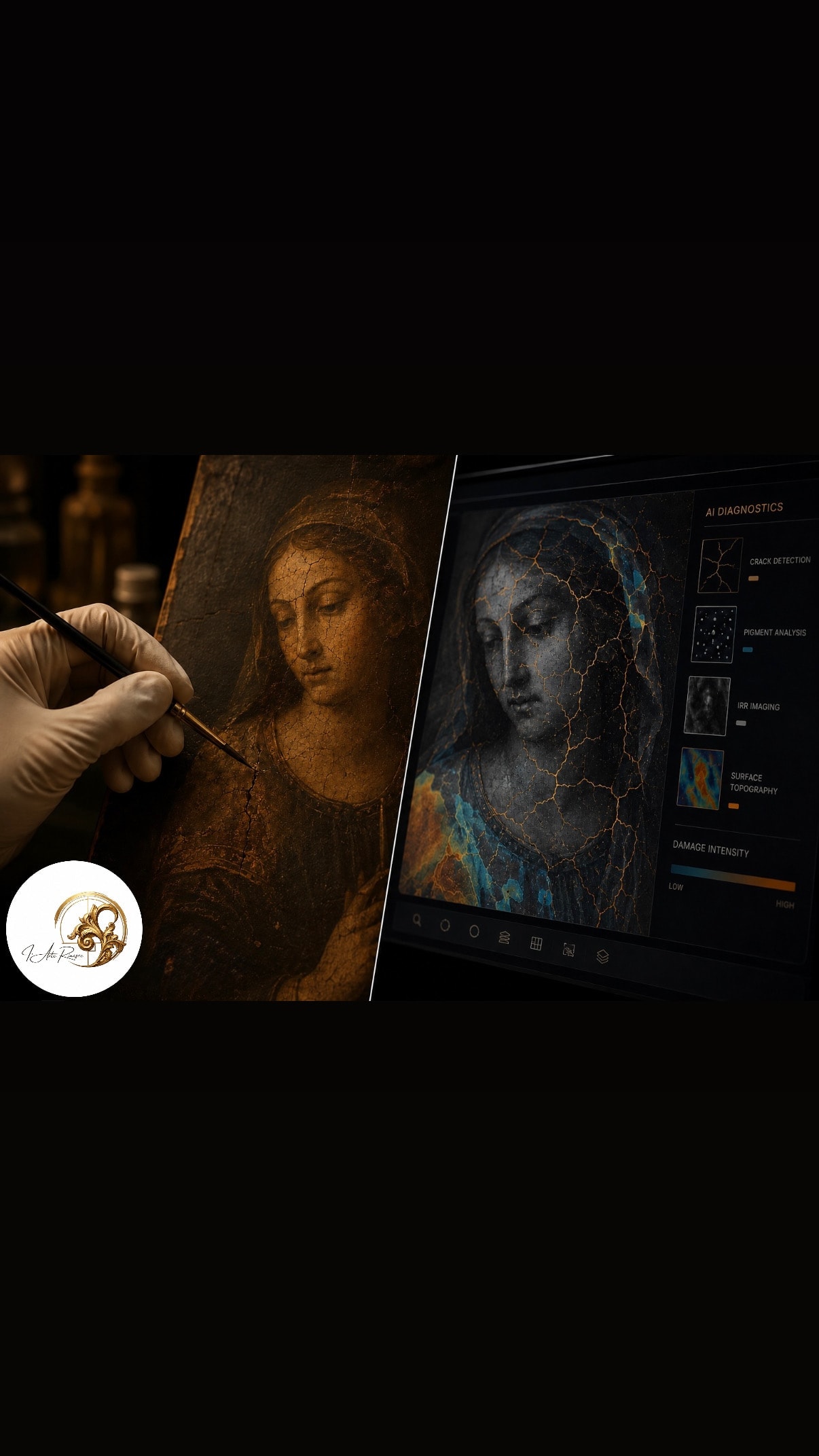
In 2011, restorers at the Gemäldegalerie in Berlin gently lifted centuries of discoloured varnish from a Vermeer portrait. As the final layer dissolved, a face emerged from shadow — luminous, immediate, almost startlingly alive.
Visitors who watched the process reported something unexpected. Tears. Not from sadness, but from a kind of recognition they couldn't quite explain.
What they experienced wasn't sentiment alone. It was biology.
The Dopamine Moment
When you stand in front of a painting that moves you, your brain doesn't simply register colour and form. It releases dopamine — the same chemical that floods your system when you fall in love.
This isn't poetic exaggeration. It's the foundational finding of neuroaesthetics, the field pioneered by UCL neuroscientist Semir Zeki in the late 1990s. His research showed that viewing visual art activates the brain's reward circuits in measurable, repeatable ways. The visual cortex processes the work. The limbic system assigns it emotional weight. The nucleus accumbens — your brain's pleasure centre — lights up.
Art, it turns out, isn't just seen. It's experienced, chemically.
What Happens When the Work Is Damaged
Here's what most people don't know: that response is fragile. It depends entirely on what the brain actually receives.
A cracked varnish. A shifted colour. A lifting paint layer. Before you consciously notice any of this, your brain has already registered that something is wrong — and quietly pulled back from full engagement.
Researchers at the Max Planck Institute for Empirical Aesthetics found that contemplative, sustained engagement with art activates the default mode network — the same brain system involved in memory, introspection, and deep reflection. It's the neurological state we associate with being truly moved by something.
But that activation isn't automatic. A degraded painting interrupts it. The brain becomes distracted by what's missing, unable to settle into the quiet, open attention that great art requires.
This is the part art conservation exists to protect.
Restoration Doesn't Add. It Reveals.
There's a common misconception that art restoration changes a painting — that it imposes something new onto an old work.
The opposite is true.
A conservator's job is not to reinterpret the artist's intention. It's to remove what has been standing in the way of it — the grime, the oxidised varnish, the structural damage accumulated over decades or centuries — so the original work can reach the viewer the way it was always meant to.
When restorers cleaned the Sistine Chapel ceiling in 1994, the world saw Michelangelo's true palette for the first time in four centuries: vivid pinks, sharp yellows, luminous greens, all previously hidden beneath soot and old varnish. Visitor studies conducted afterward found measurably elevated mood and longer attention spans compared to the pre-restoration baseline.
The controversy that followed — some critics preferred the darker, more "solemn" version — was itself revealing. Those critics weren't disagreeing about taste. They were, in neurological terms, responding to a different artwork entirely. One shaped by four hundred years of accumulated grime, rather than by the artist's hand.
Condition isn't neutral. It determines what your brain is allowed to receive.
This is the essence of painting restoration as a discipline: not reinvention, but recovery.
The Stress Response — and Why It Matters Beyond the Art World
The psychological case for art extends well beyond aesthetics.
A University of Westminster study found that a single lunchtime gallery visit lowered cortisol — the body's primary stress hormone — by an average of 32%. A 2019 study published in JAMA Psychiatry linked regular museum engagement to reduced risk of depression and anxiety, particularly in older adults.
Hospitals have taken note. Chelsea and Westminster Hospital in London has maintained an active arts programme since 1993, with independent evaluations showing reduced patient anxiety and shorter recovery times.
But here's the part that's rarely discussed: none of this works if the art itself isn't properly maintained. A hospital corridor lined with deteriorating, poorly conserved paintings isn't offering the same therapeutic value as one lined with well-preserved work. The benefit depends on condition — which depends on fine art preservation and ongoing art collection management.
Why Authentication Changes What You Feel — Not Just What You Own
There's a particularly striking finding in neuroaesthetic research: context changes neurological response, even when the image itself doesn't change.
Studies have shown that viewers who believe they're looking at a genuine Rembrandt show significantly greater activity in their brain's reward centres than viewers told they're looking at a copy — even when shown the exact same image.
Artwork authentication, in other words, isn't just a market formality. It's a form of permission your brain needs in order to fully engage. Uncertainty doesn't just lower commercial value. It quietly diminishes the experience itself.
This is why rigorous authentication — combining connoisseurship, provenance research, and scientific testing — matters as much for the viewer's experience as it does for the collector's investment.
What This Means for Collectors
If condition shapes neurological response, and response shapes meaning, then conservation isn't a maintenance line item. It's central to why a collection exists at all.
A few implications worth sitting with:
A well-conserved painting doesn't just hold its value better at auction — though it does. It continues doing the job art is supposed to do: reaching the people who stand in front of it.
An artwork condition assessment before acquisition isn't only due diligence. It's the first step in understanding whether a work can still deliver the experience that justified buying it in the first place. This is where informed art advisory and art valuation work together — assessing not only market position, but the physical integrity that underwrites it.
For cultural institutions, public art isn't decoration. It's infrastructure for collective memory, identity, and — as the research increasingly shows — public wellbeing. This is also why cultural heritage preservation carries weight well beyond any single collector or institution.
The Quiet Truth at the Centre of This Work
This was never really about maintenance.
It was always about memory. About feeling. About the particular kind of attention that happens when something true reaches you clearly, without interference.
When a conservator stabilises a flaking paint layer, they're not simply preserving pigment. They're preserving a moment of recognition — the one Berlin gallery visitors felt in front of that Vermeer. The one your brain is, quite literally, wired to seek out.
Every discipline involved in caring for art — conservation, restoration, authentication, valuation, advisory — exists to protect one thing: art's power to move you, fully and without obstruction.
That's not a sentimental idea. It's a neurological one.
At I'Arte Rinasce, we believe every artwork carries a story worth preserving. Whether you require conservation, restoration, authentication, valuation, or collection advisory services, our team is committed to safeguarding cultural and artistic legacies for future generations.
Contact I'Arte Rinasce for a confidential consultationFrequently Asked Questions
What is neuroaesthetics, and how does it relate to art restoration?
Neuroaesthetics is the scientific study of how the brain responds to art, pioneered by UCL neuroscientist Semir Zeki. It shows that viewing art activates the brain's reward circuits — a response that depends on the condition of the work, which is why art restoration and conservation directly influence the viewer's neurological experience.
Why does a damaged or discoloured painting affect how the brain responds to it?
Before a viewer consciously registers cracked varnish, colour shift, or paint loss, the brain has already detected the disruption and pulled back from full engagement, interrupting the sustained attention associated with the default mode network.
Does restoration change the meaning or intention of an artwork?
No. A conservator's role is to remove accumulated damage — grime, oxidised varnish, structural deterioration — not to reinterpret the artist's work. Properly executed restoration reveals the original intention rather than imposing a new one, guided by principles of minimal intervention and reversibility.
Can viewing art actually reduce stress?
Research supports this. A University of Westminster study recorded an average 32% drop in cortisol after a single gallery visit, and a 2019 JAMA Psychiatry study linked regular museum engagement to reduced anxiety and depression risk.
Why does knowing a painting is authentic change how it feels to look at it?
Neuroaesthetic studies show viewers exhibit stronger reward-centre activity when they believe a work is genuine versus a copy, even when viewing an identical image. Artwork authentication therefore shapes not only market value but the felt experience of the work.
What role does art conservation play in hospitals and public spaces?
Institutions such as Chelsea and Westminster Hospital have used art programmes since 1993 to support patient wellbeing, with evaluations showing reduced anxiety and shorter recovery times — benefits that depend on the artworks being properly maintained.
How should collectors factor conservation into an acquisition decision?
An artwork condition assessment should be part of due diligence alongside authentication and valuation. Condition determines both long-term market performance and whether a work can still deliver the experience that motivated its acquisition.
What is the difference between art conservation and art restoration?
Conservation focuses on stabilising and protecting a work to prevent further deterioration; restoration addresses existing damage to recover the artist's original intention. The two disciplines work together under shared principles of reversibility and minimal intervention.