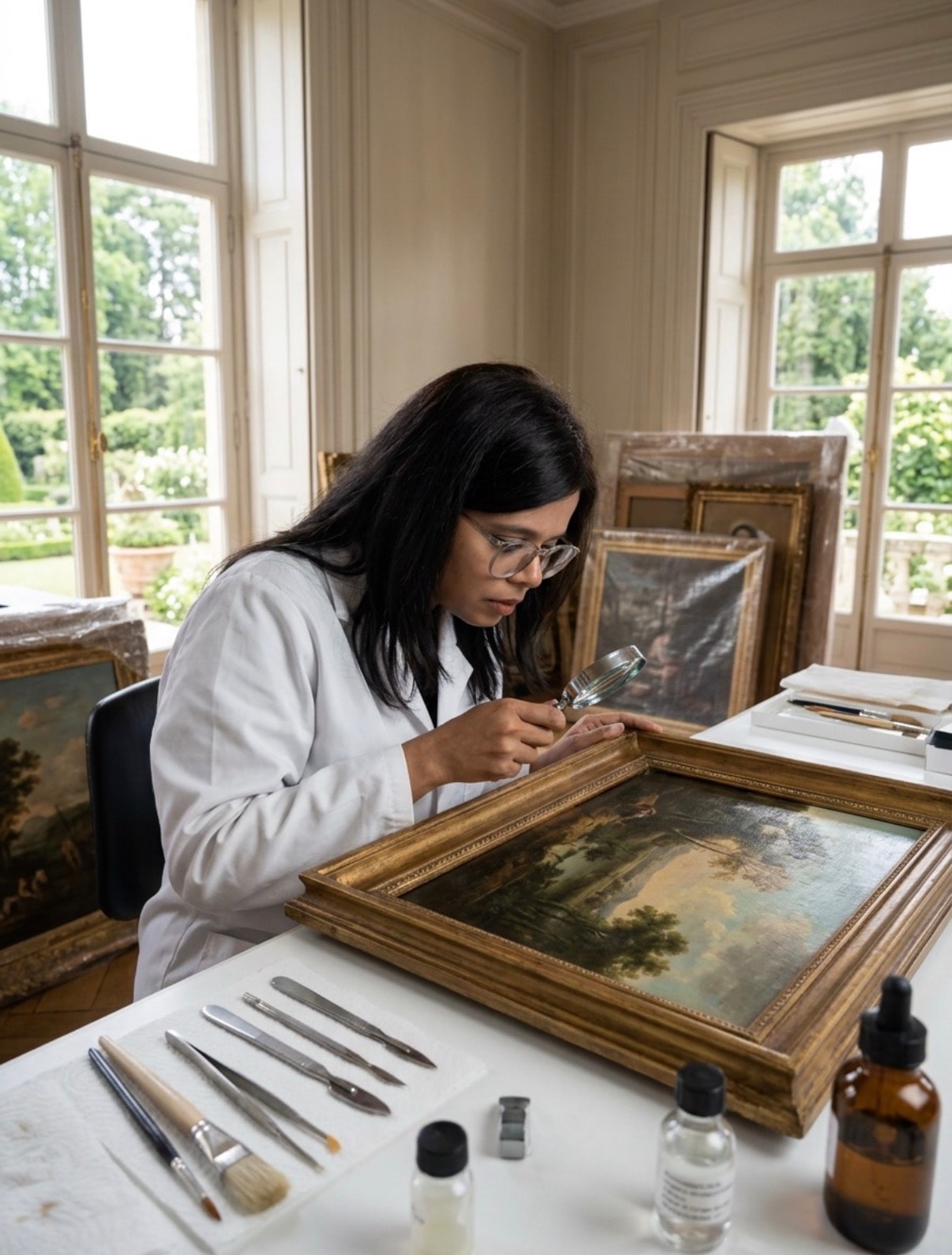
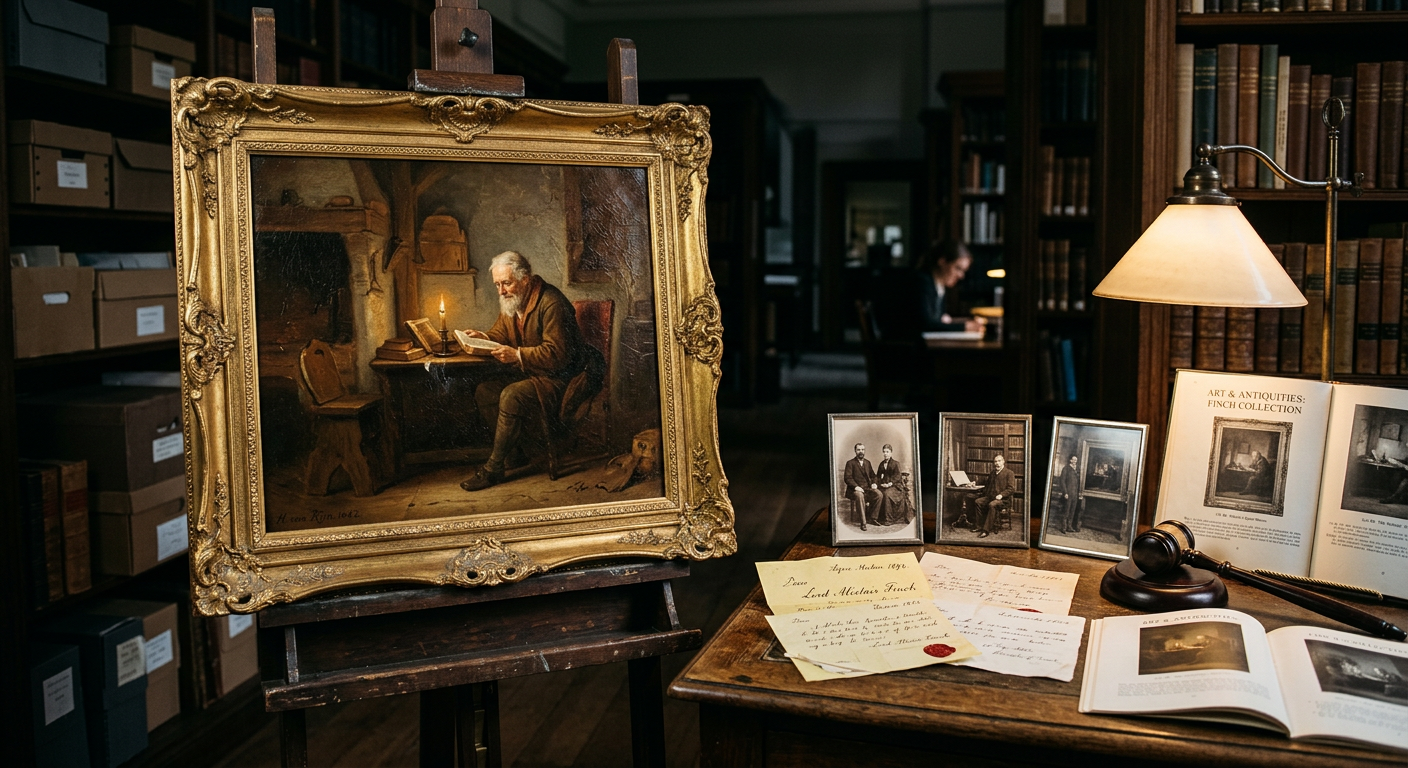
There's a painting in your home you've probably stopped seeing. Not because it isn't beautiful — because it has hung there so long that it has become part of the wall itself, the way a familiar face is often the hardest one to really look at. Most of us think about art conservation the way we think about a roof: something to deal with eventually, if it ever becomes urgent. Rarely as a decision that matters now, today, while everything still looks fine.
And yet condition is one of the most direct measures of what an artwork is worth. The figures behind that are more precise than most people expect. Fading alone can quietly remove 40 to 50 percent of a work's value. Unresolved paint loss can cost a quarter to half. A canvas that has rippled beyond conservation can lose as much as four-fifths of what it once was. These aren't scare tactics — they're the working language appraisers use every day, the quiet arithmetic behind a phrase like "in original condition."
I want you to spend a few minutes thinking through what it actually means to care for a work of art — and why that care turns out to be inseparable from what it's worth, both to you and to whoever inherits it next.
Condition is a kind of memory
Every artwork carries two records: its history, and its physical state. Provenance tells a buyer, or an heir, or a museum, where a work has been. Condition tells them what it is, right now — what has survived, and how carefully. A well-documented, stable painting with a clean conservation history will consistently outperform an equivalent work whose condition was simply left to chance, even when both pieces are by the same hand, from the same year, of comparable quality.
This is why a proper condition assessment belongs at the centre of how you think about a collection, not somewhere at its edges. Done well, it's less a technical procedure than an act of attention — the kind you'd want someone to pay to anything you hoped would outlast you.
Here's a small exercise worth trying this week: stand in front of the piece you love most. Not a glance — a real look, ideally with a lamp held low so the light rakes across the surface. You're not hunting for flaws; you're looking the way you did the first time you brought it home. Most damage isn't dramatic. It's the kind that becomes invisible precisely because you see the work every single day.
What proper care actually does
Here, at least, the evidence is reassuring. Appraisers are broadly consistent on one point: restoration carried out to a professional standard does not itself take value away. As one puts it plainly, "restoration is a huge part of value determination. If restored correctly, there is no loss in value." The risk was never in the act of restoring. It's in who does it, and how carefully.
It helps to separate two things people often blur together. Structural conservation — consolidating flaking paint, correcting a compromised canvas — is about survival: keeping the object here at all. Cosmetic restoration — inpainting a loss, adjusting a varnish — is about legibility: letting the work be read as intended. The market is far less forgiving of the second. Work that oversteps, even slightly, can become the very condition problem it was meant to solve — the whole argument for choosing a trained conservator over a generalist restorer, however capable the latter seems.
"The risk was never in the act of restoring. It is in who does it, and how carefully."
A note on honesty
It's common, in writing about art, to see conservation credited with headline auction results — the suggestion being that a good clean can turn a painting into a record-breaker. I'd rather be straightforward about where that claim holds up, and where it doesn't. Leonardo's Salvator Mundi, Rembrandt's The Night Watch, Van Gogh's The Starry Night — all have been conserved at points in their history, and all have gone on to extraordinary valuations. But crediting the conservation for the price mixes up two very different things: the rarity and historical weight that overwhelmingly set the number, and the care that simply kept the work in a state where its true value could be seen at all.
I say this because it matters to how you think about your own decisions. Care for a work because it deserves care — not because you expect it to manufacture value that was never really there.
A story like yours, probably
A painting, thirty years on the same wall
Picture a mid-century oil on canvas that has hung in the same house for thirty years. Fine craquelure has spread across its surface, and a small patch near the frame edge has lost paint — not from any accident, just the slow effect of a house that breathes with the seasons. Left alone and undocumented, that quiet wear becomes a real liability: at the point of sale, an appraiser could reasonably discount the work 20 to 30% for the craquelure alone.
Now picture the other version. An assessment identifies the cause as ordinary environmental change. A conservator stabilises the area with reversible, documented materials, and that record is filed alongside the painting's provenance. The insured value holds. The saleability holds. And the owner now has something new: a documented history of care that becomes part of what the next buyer, or the next generation, is paying for.
It's rarely dramatic damage that costs a collection value. It's the slow, unnoticed kind, left alone only because no one ever really looked.
Living with a collection well
The collectors who protect what they own most don't treat conservation as an emergency response. They treat it as a rhythm — closer to how you'd think about your own health, or a garden you actually tend rather than water only when it wilts. In practice, that means a handful of unglamorous habits: an assessment on a schedule that fits the collection; attention to light and humidity, since most loss is gradual and preventable; a file, kept per work, where treatment history lives alongside provenance; and, before any treatment begins, a second opinion from someone with no stake in the outcome.
None of this is complicated. It's preservation practiced at the scale of a home rather than a museum — the same discipline, applied with the same seriousness, to something that happens to also be yours.