

Paper Conservation
Discovery of a Masterpiece
Medium
Ink and pigment on paper
Treatment
Structural Separation & Consolidation
Damage Type
Structural Damage
When the artwork first arrived at the studio, the effects of time were unmistakable. Decades of aging, combined with severe water damage, had left this important work by an Indian Modern Master structurally vulnerable and visually compromised. What followed was one of the most demanding conservation challenges of my career — a meticulous process of assessment, stabilization, and restoration aimed at preserving both the physical artwork and the legacy it represents.
Initial Examination & Diagnosis
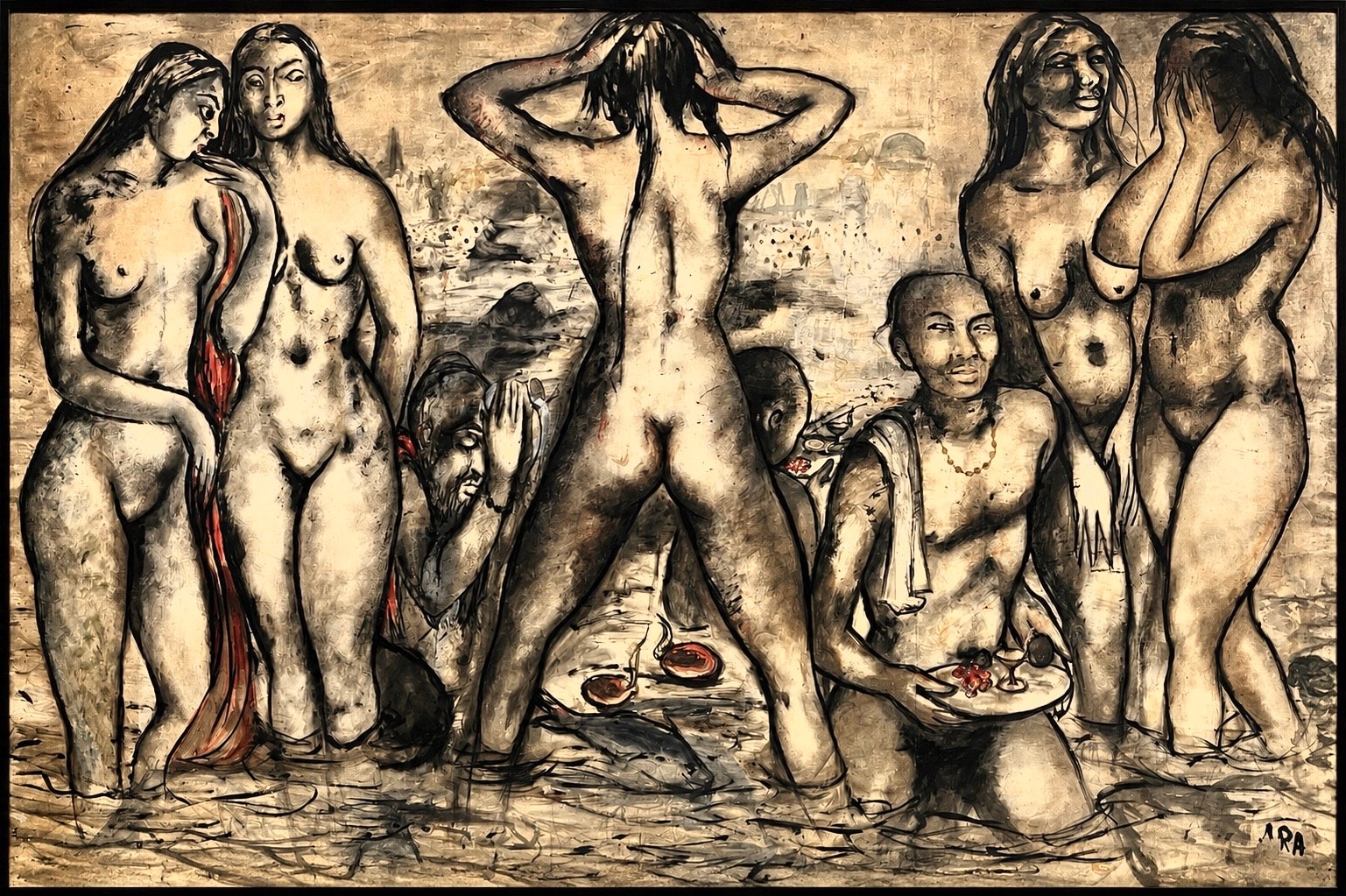
Upon arrival at the studio, the artwork presented a complex conservation challenge. The work was adhered to a wooden support and, along its entire length, partially attached to a second sheet of comparable dimensions. Preliminary examination revealed the presence of a commercially manufactured adhesive that had been unevenly applied to the verso of the upper sheet, causing extensive adhesion between the two works. Fibre analysis confirmed that both sheets were executed on laid paper of similar manufacture and hot-pressed characteristics, making visual differentiation at the points of adhesion particularly difficult. pH testing indicated moderate acidity in both papers, consistent with natural ageing and prolonged storage under suboptimal conditions. Further examination revealed significant losses in the upper right section of the artwork, where portions of the original support were missing. The treatment therefore required not only the careful separation and stabilization of the adhered sheets, but also the sensitive reconstruction of the missing area to restore the artwork's structural integrity and visual coherence while respecting its historical authenticity.
Treatment Methodology
A staged humidification protocol was developed, introducing controlled moisture through Gore-Tex membranes to soften the adhesive without saturating the paper fibres. Japanese tissue facing was applied to the recto of the upper sheet in sections to provide structural support during separation. Working across a purpose-built suction table, the conservator separated the sheets over a period of two weeks, advancing no more than a few centimetres per session to monitor the response of both works. Where the adhesive had caused localised fibre transfer, micro-consolidation with a dilute methylcellulose solution was employed.
Structural Repair & Inpainting
Following separation, both sheets were washed to reduce acidity and remove residual adhesive. Tears and losses along the adhesion line were repaired using toned Japanese tissue fills, matched in weight and texture to the original paper. Inpainting was carried out in watercolour and dry pigment, applied under magnification to integrate the repaired areas with the surrounding surface. The final result preserves the visual integrity of both works without obscuring the evidence of their history.
Drag to Compare

Outcome & Preservation
Both works were successfully separated and are now housed individually in archival enclosures within a climate-controlled environment. A full conservation dossier — including photographic documentation at each stage, fibre analysis reports, and treatment records — was prepared for the collector. The underlying work, revealed for the first time in an estimated forty years, proved to be a significant discovery in its own right.
"The underlying work, concealed for decades, was revealed in near-complete condition — a discovery that transformed our understanding of the collection."
Aishwarya Ch
Technical Methods Employed
Fibre analysis, pH testing, UV fluorescence examination, Gore-Tex humidification, Japanese tissue facing, methylcellulose consolidation, watercolour and dry pigment inpainting.
Begin a Conversation
Does Your Work Require Attention?
Every conservation enquiry begins with a conversation. Contact our team to discuss your work in complete confidence.